Printable PDF · 76 cards · 57 pages · $7
Rock & Mineral ID Field Cards
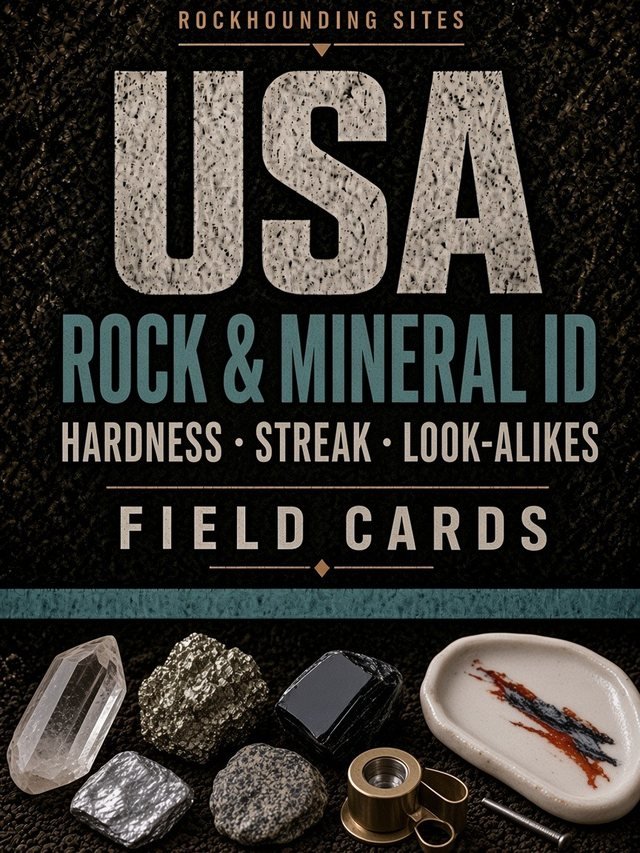
Printable rock and mineral identification cards for the United States: 42 minerals, 22 rocks and 12 collectibles, each with Mohs hardness, streak, luster, heft, look-alikes and the quick field test that settles it.
What’s on every card
- Mohs hardness with a 10-step scale bar and the household tool that scratches it
- Streak color as a printed swatch, plus luster, cleavage or fracture and crystal shape
- Heft (specific gravity) so you can tell heavy galena or gold from light look-alikes
- Look-alikes: pyrite vs gold, quartz vs calcite, obsidian vs slag, and how to tell them apart
- Key tells, where to find it in the US and a highlighted quick test
- A drawing of the crystal habit or rock texture, typical colors and a QR code to the live page
The 76 cards
- 42 minerals
- Metallic (gold, pyrite, galena, magnetite, hematite, native copper…), soft (talc, gypsum, halite, micas), medium (calcite, fluorite, malachite, turquoise, opal…) and hard (feldspars, quartz, amethyst, jade, garnet, tourmaline, beryl, topaz, corundum…)
- 22 rocks
- Igneous (granite, pegmatite, basalt, obsidian, pumice, rhyolite, tuff…), sedimentary (sandstone, shale, conglomerate, limestone, chert, coal…) and metamorphic (slate, schist, gneiss, marble, quartzite)
- 12 collectibles
- Petrified wood, geodes, thundereggs, septarians, fossil shells, Petoskey stones, shark teeth, meteorites, Yooperlites, slag glass, hag stones and arrowheads
Also inside
- Mineral key and rock key that send you straight to the right card
- Mohs hardness scale with the hardness of popular rocks and gems
- Streak and luster charts, crystal shapes and breaks, and two pages of look-alike showdowns
- ID kit and safety page, A–Z index with nicknames, ID logs and printable specimen labels
No photos to mislead you: the cards use clear drawings, color swatches and test results. For photos and places to collect, follow the QR codes to pages like quartz, agate and gold, or read fool’s gold vs real gold and the Mohs hardness scale.
How to use them
Print the cards, cut them in half and keep the ones you need in a field bag. Test a hidden edge of your specimen, not its best face. Field tests narrow the choices; they do not replace lab analysis, and you should always confirm collecting rules with the land owner or manager before you collect.
Questions
- How do I identify a rock or mineral I found?
- Start with luster: does it look like metal or not? Then test hardness against a fingernail (2.5), a copper coin (3), a steel knife or glass (5.5) and a quartz point (7), and drag it across an unglazed tile to see the streak color. Heft, cleavage and a drop of vinegar narrow it further. The cards put those results side by side so you can match your specimen to a card.
- How can I tell pyrite (fool’s gold) from real gold?
- Gold is soft enough to dent with a pin, leaves a golden-yellow streak and is extremely heavy. Pyrite is brittle, scratches glass, leaves a greenish-black streak and often forms cubes. Each card lists its look-alikes and the one quick test that separates them.
- What do I need for the tests?
- A steel nail or knife, a copper coin, a piece of glass, an unglazed porcelain tile for streak, a magnet, a 10x hand lens and a little white vinegar. The ID kit page lists each item, what it tells you and a typical cost.
- What format are the cards?
- A 57-page US Letter PDF with two cards per page, made for printing and cutting out. It also includes ID keys, a Mohs hardness chart, streak and luster charts, an A–Z index with nicknames, ID logs and specimen labels.