A wishing stone (wish stone) is a smooth rock with one unbroken white or quartz stripe running fully around it — often banded chert or agate found on Great Lakes beaches, desert agate fields, and river gravel bars after storms.
A wishing stone (also called a wish stone) is a smooth pebble with a single unbroken stripe — usually white quartz or light chert — running completely around its circumference. Beachcombers make wishes on them; rockhounds recognize the same pattern as banded chert, ribbon agate, or fortification agate worn round by water.
This guide explains the folklore, the geology, and where to search in the United States.
Folklore vs. geology
| Wishing stone rule (folk) | Geology reality |
|---|---|
| One continuous stripe around the stone | Banded sedimentary chert or agate nodule |
| Smooth, water-worn shape | Cobble from beach or river gravel |
| White or light-colored band | Quartz-rich layer in iron-stained matrix |
You do not need supernatural belief to enjoy the hunt — striped cobbles are honest lapidary rough and satisfying pocket specimens.
How to identify a true wishing stone
- Pick up smooth, flattened cobbles — not angular quarry fragments
- Trace the light band with your finger — it must connect all the way around without breaking
- Wet the surface — bands show clearer when damp (carry a spray bottle)
- Check for agate structure with a 10x hand lens — fibrous or crystalline texture differs from painted sedimentary stripes
Not every striped rock qualifies. Multi-band agates without one dominant ring are beautiful but not “wishing stones” by the traditional definition.
Where to find wishing stones in the U.S.
Great Lakes beaches
Storm waves refresh Ohio and Michigan gravel bars with banded chert cobbles. Lake Erie Beach Agates documents Lake Erie beachcombing after nor’easters — agate, chalcedony, and striped chert appear together.
Walk beaches in late fall and early spring when winter ice and storms strip sand away.
Desert agate fields
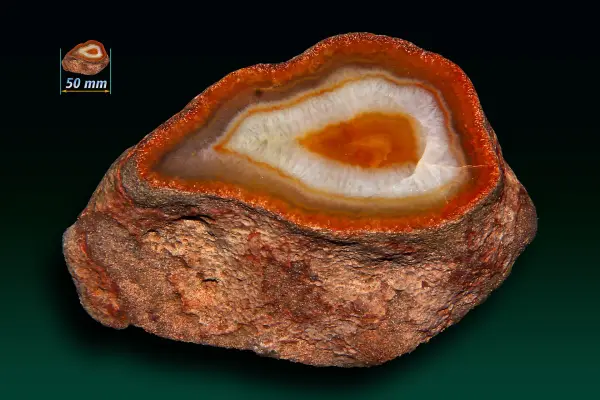
Banded agate nodules weather into striped cobbles in Wyoming and Arizona washes. Sweetwater Agate Fields and Florence Agate Area produce fortification and ribbon patterns that survive as wishing-stone candidates after tumbling in gravel.
River bars and lake shores nationwide
Any creek or reservoir with chert or agate in the watershed can yield striped cobbles. Search our agate and jasper type hub and near-me locator for local listings.
Collecting ethics
- National and state parks often prohibit removing rocks — read signs
- Take modest amounts; leave material for others
- Do not strip entire beach sections — pocket a few favorites
- Avoid culturally sensitive shoreline sites
Related guides
- What is rockhounding? — hobby basics
- Rockhounding in Ohio — Lake Erie beach agates
- Family-friendly rockhounding — beachcombing with kids
Wishing stones sit at the intersection of folklore and real geology. Whether you make a wish or slice a cabochon, the hunt for one perfect unbroken stripe is one of rockhounding’s simplest pleasures.
Spots from our directory
Lake Erie Beach Agates
Guide to banded Lake Erie beach stones, fossil coral, and glass near Marblehead, with the Ohio rule that forbids removal from state-managed land unless authorized.
View detailsFlorence Agate Area
Desert benches south of Florence contain fire agate in rhyolite flows, one of Arizona's most popular gem-mineral targets for patient collectors.
View detailsSweetwater Agate Fields
Wind-scoured BLM benches near Rock Springs expose moss and fortification agate nodules in sedimentary host rock.
View detailsFrequently asked questions
What is a wishing stone?
A wishing stone (also called a wish stone) is a smooth rock with a single unbroken white or quartz stripe running completely around its circumference. Beachcombers and rockhounds collect them for folklore luck; geologically they are often banded chert, agate, or ribbon jasper.
Are wish stones the same as wishing stones?
Yes — “wish stones” and “wishing stones” refer to the same striped beach or river cobbles with one continuous band around the stone.
Where can you find wishing stones?
Lake and ocean beaches with chert or agate cobbles — Great Lakes shores, Pacific Northwest gravel bars, and desert washes with banded agate — yield striped stones after storms erode fresh material.
Are wishing stones the same as agates?
Not always. True wishing stones need one continuous band around the entire stone. Many banded agates qualify; plain striped sedimentary rocks may look similar but lack agate structure.
Can you collect wishing stones on public beaches?
Rules vary. National park and some state park beaches prohibit removing rocks. Great Lakes and many river beaches allow modest collecting — verify local regulations.
Do wishing stones have geological value?
Banded chert and ribbon agate are legitimate lapidary materials. Wishing stones with complete white rings are collector curiosities; quality banded slabs cut well for cabs.